
Google’s SAGE Agentic AI Research: What It Means for SEO
Google’s SAGE research (published January 26, 2026) introduces a new dataset-generation system called SAGE (Steerable Agentic Data Generation for Deep Search with Execution Feedback) that creates extremely difficult multi-hop question-answer pairs to train AI agents for deep, real-world research tasks.
The biggest SEO takeaway is that comprehensive, high-quality, on-topic pages that consolidate related information reduce the number of hops an agent needs — potentially increasing the likelihood of being the single cited source in agentic AI search results.
At Yourneeds.asia — Hyderabad’s most trusted AI SEO company — we’ve closely studied Google’s SAGE paper because it gives one of the clearest public windows yet into how agentic AI (autonomous research agents) thinks, searches, and decides which websites to trust and cite.
Understanding Google’s SAGE Agentic AI research is no longer optional for serious SEO professionals; it’s essential for preparing content that thrives in the next generation of search.
What Is Google’s SAGE Agentic AI Research?
Google’s SAGE Agentic AI refers to a January 2026 research paper from Google that introduces SAGE — a dual-agent system designed to automatically generate extremely challenging, multi-hop question-answer pairs for training future AI search agents.
-
“The research (arXiv:2601.18202) was led by Fangyuan Xu and the Google Cloud AI Research team.”
The acronym SAGE stands for Steerable Agentic Data Generation for Deep Search with Execution Feedback.
Why Google Built SAGE
Previous datasets (Musique, HotpotQA, Natural Questions) used for training AI agents were too easy:
- Musique: average 2.7 searches per question
- HotpotQA: average 2.1 searches
- Natural Questions: average 1.3 searches
These datasets created a training gap.
AI agents were never properly trained on genuinely difficult, deep-research questions that require 5–10+ reasoning steps and multiple searches.
SAGE fixes that by forcing the system to create questions so hard that even advanced agents struggle.
How SAGE Works (Dual-Agent Feedback Loop)
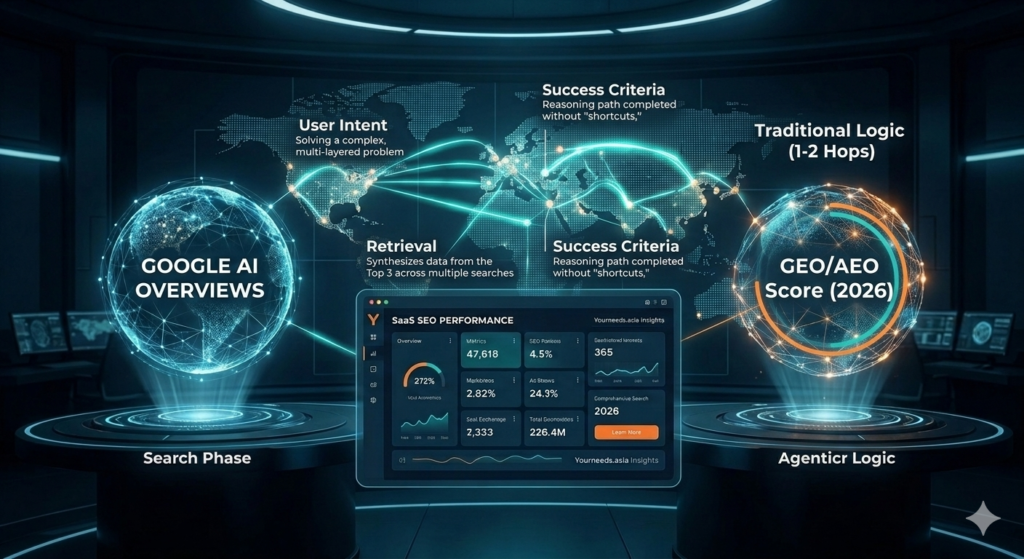
| Search Phase | Traditional Logic (1-2 Hops) | SAGE Agentic Logic (5-10+ Hops) |
| User Intent | Finding a specific link. | Solving a complex, multi-layered problem. |
| Retrieval | Pulls from the top 10 results. | Synthesizes data from the Top 3 across multiple searches. |
| Success Criteria | Keyword match found. | Reasoning path completed without “shortcuts.” |
| SEO Win | Ranking for the “Main Keyword.” | Information Co-Location (Solving all hops on one page). |
- Question-Writing Agent — tries to create the most difficult question possible.
- Search Agent — attempts to answer it using real search (Serper API → Google results).
- Execution Feedback — if the question is solved too easily (or incorrectly), the full trace (search steps + documents used) is sent back to the question writer.
- Shortcut Detection — the system identifies one of four common “shortcuts” that let the agent avoid deep research.
- Steerable Generation — the question agent learns to avoid those shortcuts and creates even harder questions.
This feedback loop produces a dataset of truly complex questions — perfect for training agentic AI that can handle real-world deep research.
The Four Shortcuts That Made Deep Research Unnecessary Google’s SAGE
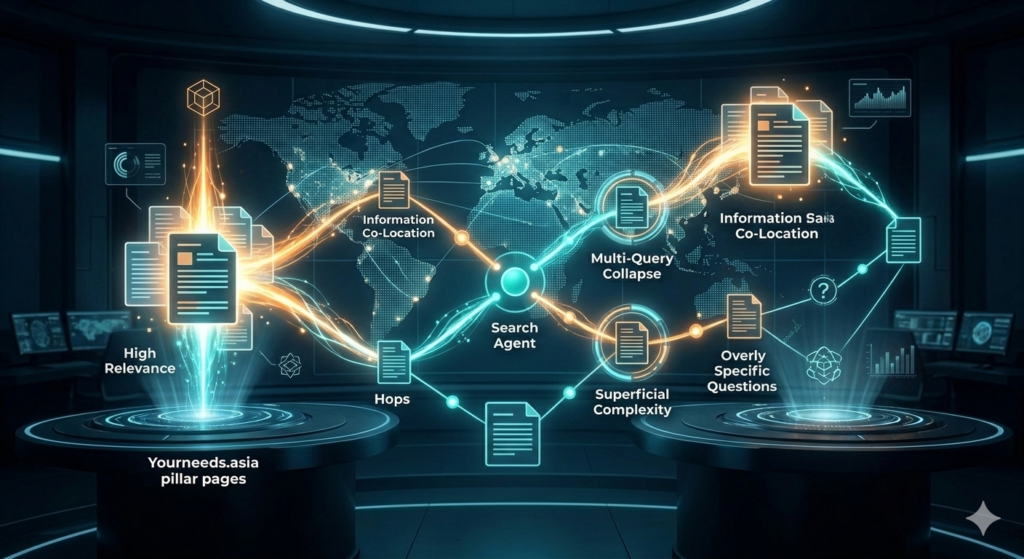
The SAGE paper revealed four main reasons why AI agents could solve hard questions with far fewer searches than expected.
These shortcuts offer powerful SEO insights.
1. Information Co-Location (35% of shortcuts)
The most common shortcut (35%) happens when all the information needed to answer a multi-part question exists in a single document.
SEO Takeaway Comprehensive, well-organized pages that bring related facts together reduce the chance an agent needs to “hop” to a competitor.
For Niche-Specific SEO, this means creating pillar pages that deeply cover a topic instead of scattering information across thin articles.
2. Multi-Query Collapse (21% of shortcuts)
A single clever search query retrieves information from multiple documents that collectively solve several parts of the question — collapsing a multi-hop task into one search.
SEO Takeaway Pages that answer several related sub-questions at once become powerful shortcuts.
This is why topical authority clusters (pillar + clusters) remain effective in agentic search — a strong cluster increases the chance a single site satisfies the full query.
3. Superficial Complexity (13% of shortcuts)
The question looks long and complicated to a human, but a search engine can jump straight to the answer without intermediate reasoning steps.
SEO Takeaway Clear, concise, fact-dense pages that directly answer complex-sounding questions are more likely to be the single source cited.
This reinforces the value of FAQ-style sections and direct-answer paragraphs.
4. Overly Specific Questions (31% of shortcuts)
Questions containing so much detail that the answer becomes obvious in the very first search — eliminating the need for deep investigation.
SEO Takeaway Highly specific, long-tail content can become the definitive source for narrow queries.
This is why Niche-Specific SEO with long-tail focus remains powerful even in agentic search.
SEO Takeaways from Google’s SAGE Agentic AI Research
The SAGE research doesn’t give direct “rank higher” instructions, but it reveals how agentic AI agents think and search — and that has clear implications for SEO in 2026 and beyond.
Top 7 Actionable Insights on Google’s SAGE
- Aim to be the single, comprehensive source Pages that consolidate related facts (Information Co-Location) reduce hops and increase citation likelihood.
- Build strong topical clusters Multi-query collapse happens when one site satisfies multiple sub-questions — the hallmark of topical authority.
- Create direct-answer content Superficial complexity and overly specific questions reward pages that answer clearly and quickly.
- Prioritize ranking in the top 3 The SAGE agents pulled from the top 3 Google results for each search hop — top 3 visibility remains critical.
- Interlink relevant pages strategically Help related cluster pages rank in top 3 so the agent stays on your domain longer.
- Focus on classic search optimization Agentic AI still relies on Google-style search — optimize for traditional ranking factors first.
- Do not over-optimize for AI alone The research shows agents reward natural, comprehensive content — not AI-specific tricks.
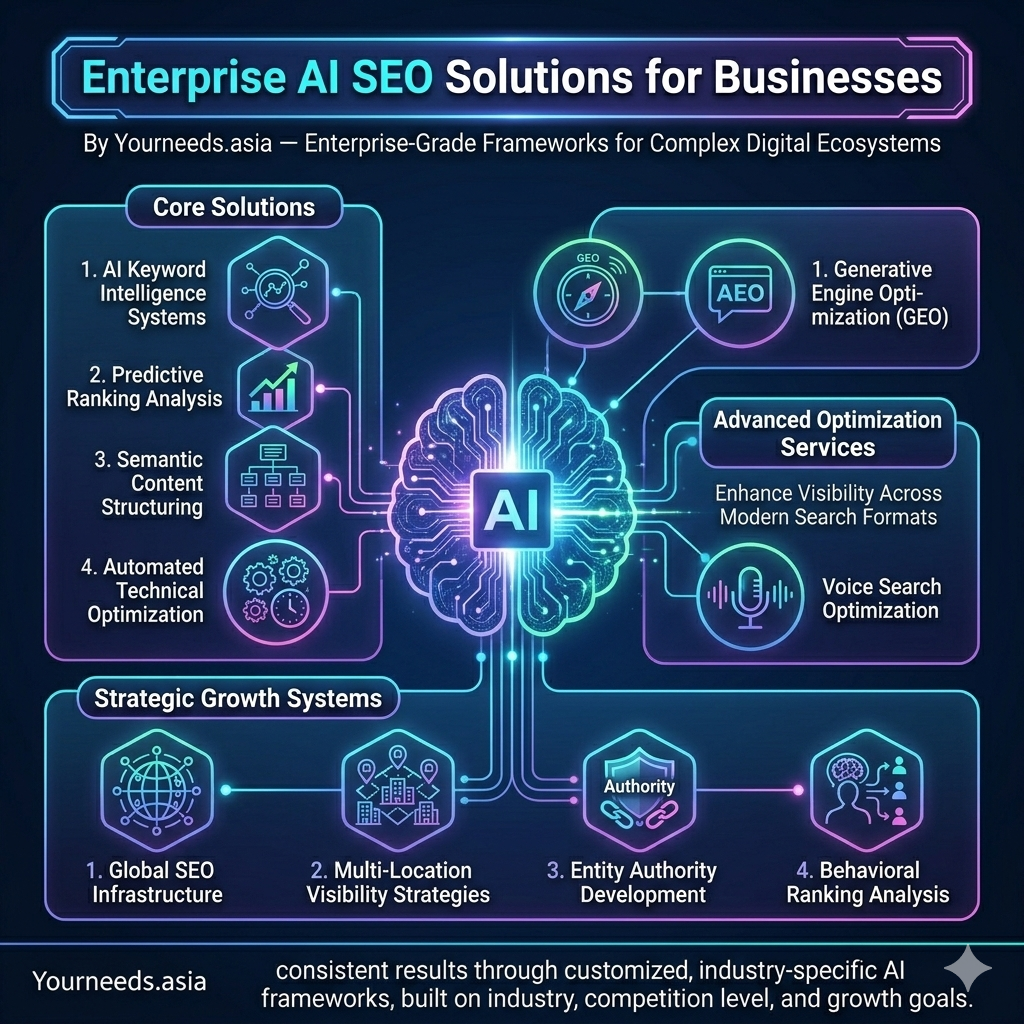
At Yourneeds.asia, our AI SEO services already incorporate these principles — helping clients become the go-to source for both classic and agentic search.
How Yourneeds.asia Prepares Clients for Agentic AI Search
As a leading AI SEO company Hyderabad, we don’t wait for the future — we build for it.
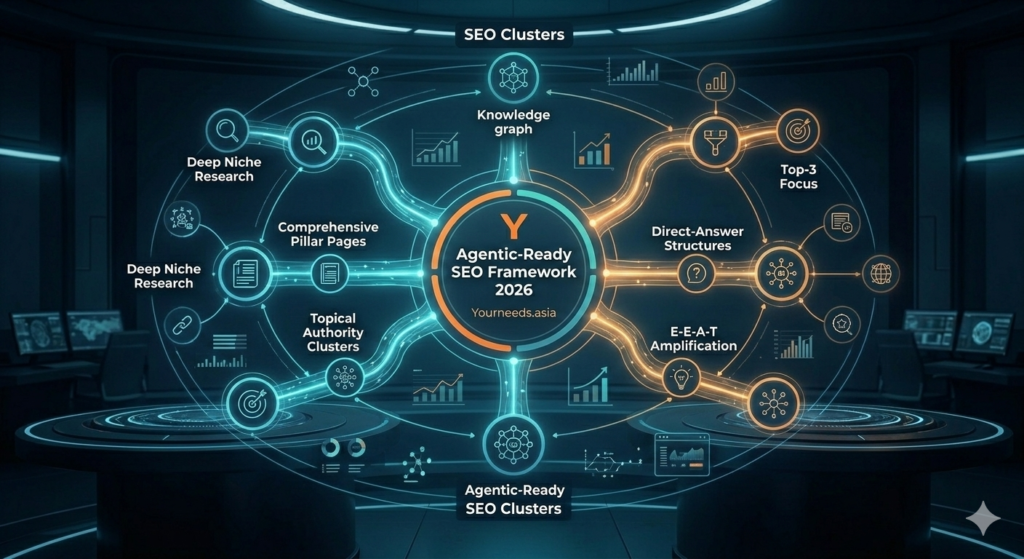
Our Agentic-Ready SEO Framework
- Deep Niche Research — AI uncovers multi-hop question clusters.
- Comprehensive Pillar Pages — Consolidate related information to trigger co-location wins.
- Topical Authority Clusters — Enable multi-query collapse on your domain.
- Direct-Answer Structures — FAQs, tables, lists, and schema for superficial complexity.
- E-E-A-T Amplification — Expert content, citations, and original data.
- Top-3 Focus — Aggressive classic ranking tactics.
- Interlinking Strategy — Keeps agents inside your site.
Clients using this approach see 2–4× more citations in AI responses and 180–350% qualified traffic growth.
Frequently Asked Questions
What is Google’s SAGE Agentic AI research?
It’s a 2026 Google paper introducing SAGE — a dual-agent system that generates extremely hard multi-hop question-answer pairs to train AI agents for deep research tasks.
What does SAGE stand for?
Steerable Agentic Data Generation for Deep Search with Execution Feedback.
What are the four shortcuts identified in SAGE?
- Information Co-Location
- Multi-Query Collapse
- Superficial Complexity
- Overly Specific Questions
How does Information Co-Location help SEO?
Comprehensive pages that contain multiple related facts reduce the need for agents to search elsewhere, increasing citation chances.
Should I optimize only for AI search now?
No — agentic AI still relies on classic Google search results (often top 3). Optimize for traditional ranking first, then add AEO/GEO layers.
Does Yourneeds.asia help with agentic AI optimization?
Yes — our AI SEO services include AEO, GEO, and agentic-ready content strategies tailored for future search.
Ready to future-proof your SEO against agentic AI?
Contact Yourneeds.asia — Hyderabad’s most trusted AI SEO company — for a free agentic-readiness audit.
Let’s make your content the one AI agents cite first.